What Are The Four Common Types Of Steel Structures
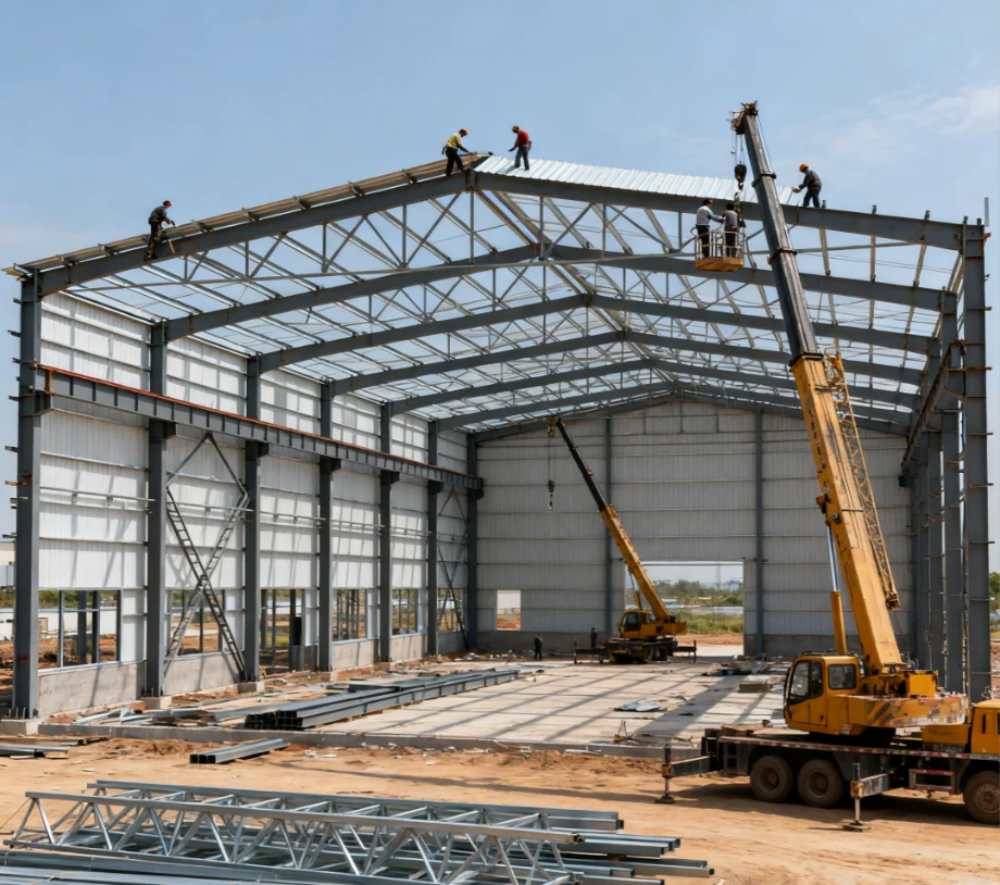
In industrial plants,logistics warehouses,commercial buildings,and large public facilities,steel structures have become one of the most mainstream building structure forms worldwide.Compared with traditional concrete structures,steel structures have advantages such as high strength,light weight,short construction period,and high recyclability,making them particularly suitable for modern construction projects that prioritize high efficiency and flexible space utilization.
However,many owners or project managers often only focus on"using steel structures"during the initial planning phase,neglecting the differences between different steel structure systems.In fact,different structural types have significant differences in load-bearing methods,cost composition,construction difficulty,spatial adaptability,and future expansion capabilities.Whether the selection is reasonable often directly affects the long-term operating costs and user experience of the project.
This article will systematically review four common types of steel structures from an engineering perspective,and combine them with internationally renowned architectural cases to help you more intuitively understand the application logic of different structural systems in real projects,providing a reference for subsequent building design choices.
Why is it crucial to consider the type of steel structure in the early stages of a project?
In actual engineering projects,the selection of steel structures is not an"optional"technical detail,but a crucial prerequisite that determines the overall performance of the building.Taking common industrial buildings as an example:
Different structural systems can result in a 15%-30%difference in steel consumption per unit of building area;
The overall construction period can vary by 20%-40%under different structural schemes;
The difficulty and cost of future renovations are also closely related to the structural system.
For example,a 5000 m²warehouse building,if using a standardized portal frame structure,can often complete the main construction in a relatively short period;while choosing a more complex frame system,although offering greater functional flexibility,will increase the initial design and construction period.Therefore,systematically evaluating the structural type in the early stages of the project is a crucial step in controlling costs and risks.
Basic Concepts and Classification Logic of Steel Structures
From an engineering perspective,steel structures mainly consist of the following core components:
Steel columns,steel beams,support systems,connection nodes,and enclosure systems.Different structural systems are essentially different combinations of these components to meet specific load-bearing and spatial requirements.Common classification methods for steel structures mainly include:
Classification by force system:Portal frame,frame structure,space frame structure,truss structure
Classification by building function:Industrial building steel structures,commercial building steel structures,public building steel structures
This article focuses on the four most representative structural systems in engineering practice and illustrates their respective application boundaries with international project cases.
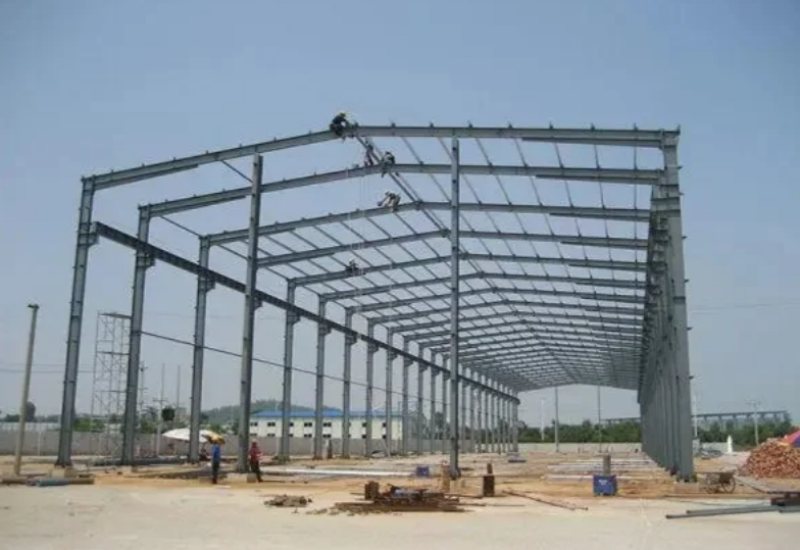
4 Common Steel Structure Types and Engineering Applications
Portal Frame Steel Structure
The mainstream choice for cost-effective industrial buildings
The portal frame steel structure uses a"column-beam rigid connection"as its core force system.It has a simple structural form and a high degree of component standardization,making it the most widely used type of steel structure in current industrial plants and logistics warehousing projects.
From an economic perspective,portal frames have a significant advantage in small to medium-span buildings.The common single-span span is generally controlled within the 18–36 meter range,and the column spacing is mostly 6–9 meters.While ensuring structural safety,the amount of steel used is relatively controllable.For standardized warehouses or production workshops,this structural form often achieves optimal cost control.
In terms of construction efficiency,the factory prefabrication rate of portal frames can usually reach 85%–90%,and on-site installation mainly uses bolted connections.The overall construction period can be shortened by about 30%compared to traditional concrete factories.This is also an important reason why it is widely used in industries sensitive to delivery cycles,such as logistics and manufacturing.
International Classic Cases
Globally,large industrial parks and warehousing facilities widely adopt steel structure systems similar to portal frames.Taking the Tesla Gigafactory in Nevada,USA,as an example,its ultra-large production plant emphasizes standardized structures and modular construction to meet the needs of rapid construction and future expansion.Similar structural concepts are also widely applied in Amazon's logistics center projects in multiple countries.These buildings emphasize large spaces,high efficiency,and low unit cost.
Summary of Applicable Scenarios
Portal frame steel structures are very suitable for:
Industrial plants,logistics warehouses,light processing workshops,and other building types mainly consisting of large-span single-story spaces.
2.Steel Frame Structure
When a building needs to accommodate multiple stories or complex functional requirements,a steel frame structure often offers significant advantages.This system consists of steel columns and beams forming a multi-story load-bearing system,allowing for flexible partitioning of internal space according to actual functional needs.
From a structural performance perspective,the frame system demonstrates stable performance in resisting both vertical and horizontal loads,making it suitable for buildings of 2–5 stories and above.For projects such as R&D centers,office buildings,or warehouses with mezzanines,the frame structure can better adapt to functional changes,facilitating future renovations and space adjustments.
In engineering practice,steel frame structures are often combined with concrete floor slabs to form a steel-concrete composite structure.This approach,while ensuring structural rigidity,helps reduce floor vibration and improves comfort for occupants or equipment operation.
International Classic Examples
In the field of high-rise buildings,Chicago's Willis Tower(formerly Sears Tower)and John Hancock Center are classic examples of steel frame systems in supertall buildings.These buildings fully demonstrate the advantages of steel structures in high-rise space organization,load-bearing efficiency,and construction speed.Although industrial buildings and high-rise commercial buildings differ in scale and function,the underlying structural logic is highly similar.
Summary of Applicable Scenarios
Steel frame structures are more suitable for:
Multi-story factories,R&D office buildings,industrial park complexes,and other projects requiring vertical space utilization.
3.Space Frame Structure
When a building needs to cover a large span while minimizing internal columns,a space frame structure is often the better choice.This system forms a stable load-bearing network through spatial members,allowing the load to be evenly distributed in multiple directions.
From an engineering performance perspective,space frame structures can cover single spans of 30–60 meters or even larger in large-span venues,while also being relatively lightweight.Compared to traditional beam structures,space frame structures can reduce the cross-sectional dimensions of components to a certain extent under the same span conditions,thus optimizing material utilization.
In terms of construction,space frame structures usually employ a modular assembly method.After the components are prefabricated in the factory,they are assembled and hoisted on-site.This method helps improve construction accuracy,but requires high levels of construction organization and on-site management capabilities.
International Classic Cases
The glass roof structure of the Louvre Pyramid entrance area in Paris,and the large-span roof system of the Munich Olympic Stadium in Germany,are typical examples of spatial structures in public buildings.These buildings achieve transparent visual effects and large-scale column-free spaces through space frame or similar spatial structural systems,balancing structural safety and architectural aesthetics.
Summary of Applicable Scenarios
Space frame structures are more suitable for:
Projects with high demands on span and spatial integrity,such as gymnasiums,exhibition centers,and large public event spaces.
4.Truss Structure
Truss structures form a stable force-bearing system through upper and lower chords and web members,resulting in high material utilization efficiency in medium and large-span buildings.Compared to solid beam structures,trusses can reduce material consumption while ensuring load-bearing capacity,thus reducing structural self-weight to a certain extent.
From an engineering application perspective,truss structures are often used in roof systems,transportation hub canopies,and industrial plant roof trusses.Their structural form is highly malleable,capable of meeting engineering stress requirements while also creating distinctive spatial forms in architectural design.
International Classic Cases
The Eiffel Tower,as one of the world's most representative steel structure landmarks,is essentially a large truss system in its overall structural logic.The Sydney Harbour Bridge also uses a large-span steel truss structure,carrying traffic loads while becoming an important landmark of the city.
Summary of Applicable Scenarios
Truss structures are more suitable for:
Projects with dual requirements for structural efficiency and visual effects,such as transportation hub roofs,industrial plant roof trusses,and large-span commercial building roofs.
Comparison and Selection Considerations of Different Steel Structure Types
From a practical engineering decision-making perspective,different steel structure systems have significant differences in the following aspects:
Span Capacity:Space frames and trusses are more suitable for large-span spaces,while portal frames are more suitable for small and medium spans;
Spatial Organization:Frame structures have advantages in multi-story spatial organization;
Construction Period:Portal frames usually have higher construction efficiency;
Cost Composition:Simple structural systems have advantages in material and construction management costs.Therefore,when selecting a structural system in the early stages of a project,a comprehensive approach should be taken,considering building function,service life,budget control,and future expansion needs,rather than making judgments based on a single dimension.
Common Misconceptions in Steel Structure Selection
In actual projects,common misconceptions mainly focus on the following aspects:
First,overemphasizing initial construction costs while neglecting the impact of the structural system on long-term maintenance costs;
Second,neglecting future functional changes,leading to increased difficulties in later expansion;
Third,failing to adequately assess local wind loads,snow loads,and seismic requirements,increasing structural safety risks.
These problems often only become apparent after the project is put into use.Rational selection and professional evaluation in the early stages can largely avoid the generation of hidden costs later on.
How to Choose a Reliable Steel Structure Design and Manufacturing Team?
From the EEAT perspective,the engineering experience and technical capabilities of a professional team are crucial for ensuring project quality.When choosing a partner,you can focus on the following aspects:
Whether they have mature engineering cases and verifiable project experience;
Whether they can provide complete structural calculations and detailed design solutions;
Whether they are familiar with international or local building codes and structural safety standards;
Whether they have a comprehensive construction support and after-sales service system.
WZHbuild:A Steel Structure Solution Provider Focused on Engineering Expertise
As a professional team specializing in steel structure building solutions,WZHbuild has accumulated extensive practical experience in industrial plants,steel structure warehouses,multi-story steel buildings,and customized engineering projects.The team provides one-stop support,from initial design consultation,structural selection recommendations,structural calculation and detailed design,to component manufacturing and on-site installation guidance,tailored to the specific needs of each project.
During project execution,WZHbuild emphasizes the integration of engineering standards with practical applications,strictly adhering to relevant international and regional building standards for structural design and manufacturing control.This ensures the safety,stability,and long-term performance of the buildings.Furthermore,relying on mature project management processes and cross-team collaboration mechanisms,WZHbuild effectively shortens project cycles,reduces communication and implementation costs,and provides clients with more feasible steel structure solutions.
Conclusion
Steel structure itself is merely a carrier of building technology;what truly determines the long-term value of a project is the rationality of the structural system selection in the early stages.Whether it's industrial plants,logistics warehouses,or public building projects,only by fully understanding the characteristics of different steel structure types and combining them with your own functional needs can you achieve a better balance between space utilization,cost control,and long-term operation.
If you are in the project planning stage,it is recommended to introduce a professional structural consultant in the early stages of the plan to compare and evaluate different structural systems,thereby reducing the uncertainty caused by later adjustments.