
Steel Structure Gymnasium Project in the United States
This project involves the construction of a medium-sized steel-structure gymnasium located in the United States. The facility features a comprehensive, large-span steel structural system designed to ensure a vast, column-free interior space while maximizing the efficient utilization of the sports grounds.
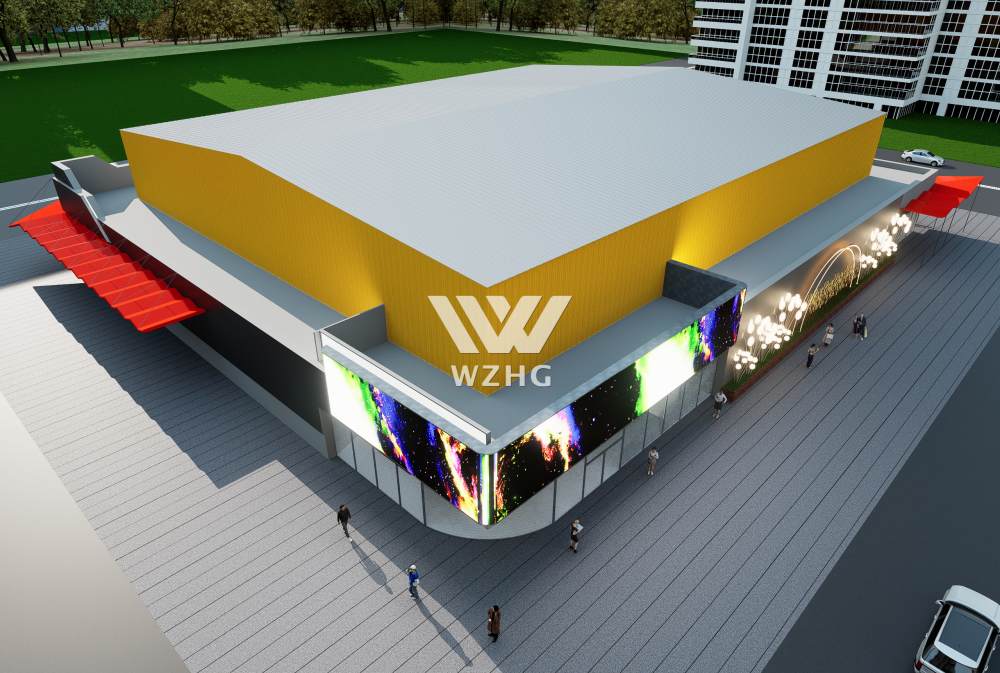
Project Location:USA
Building Area:
Building Dimensions:153'-4"×128'-6"×34'-2.6"
Footprint Area:Approx.1,830–1,850 m²(approx.19,700 sq ft)
Building Height:Approx.10.4 m(over 34 ft)
Structural Gymnasium Project Overview
This project involves the construction of a medium-sized steel-structure gymnasium located in the United States.The facility features a comprehensive,large-span steel structural system designed to ensure a vast,column-free interior space while maximizing the efficient utilization of the sports grounds.
The building is primarily intended for multi-functional athletic activities and is adaptable for use in basketball,badminton,indoor training,community events,and competitive tournaments.The structural design prioritizes spatial openness and safety performance,making it ideally suited for high-traffic public sports facilities.
WZHbuild Steel Gymnasium:Structural and Design Highlights
WZHbuild provided comprehensive structural design and construction support for this project.The structural system was optimized in accordance with U.S.standards for sports facilities and design codes for large-span steel structures;the overall solution strikes a balance between safety,cost-effectiveness,and construction efficiency.
1.Large-Span,Column-Free Space Design(Max Span:128'-6")
The project employs a composite structural system combining portal rigid frames with a spatial load-bearing framework.The maximum single span measures approximately 39.1 meters(128'-6"),creating an interior that is completely free of intermediate columns—thereby achieving a 100%unobstructed sports space.
Accommodates a standard basketball court(28 m×15 m)plus the required safety buffer zones.
Interior clear height:Approx.10.4 m(34'-2.6").
Enhanced visual field utilization:Approx.30%–40%improvement(compared to traditional concrete structures).
2.High-Strength Steel Structural System
The main steel structure utilizes a Q235 carbon structural steel system,featuring a material yield strength of approximately 235 MPa.While fully satisfying structural safety requirements,the design employs rational structural planning and load optimization to ensure stable load-bearing performance across the gymnasium's expansive interior space.In terms of structural design,safety redundancy factors are typically maintained within the range of 1.5 to 1.8,ensuring long-term reliability and stability.
Regarding load design,this project allows for wind load adjustments based on the specific building codes of various regions across the United States.Its wind-resistance capacity can reach up to approximately 1.0–1.5 kPa,making it suitable for the operational environments of most standard sports facilities.Concurrently,the seismic design meets the requirements for US Seismic Categories C through D,enabling the structure to withstand conditions in regions with moderate to high seismic activity.
Although the structure utilizes a Q235 steel framework,structural optimization—such as the integration of portal frames,truss systems,and bracing systems—allows the overall structural self-weight to be reduced by approximately 60%to 70%compared to traditional concrete buildings.This approach significantly enhances both cost-efficiency and construction efficiency while fully maintaining safety standards.
3.Modular Pre-fabrication and Rapid Installation System
This project employs a construction model combining factory pre-fabrication with on-site assembly:
•Factory Pre-fabrication Rate:85%–95%
•On-site Installation Duration:Approximately 30–60 days to complete the main structure
•Construction Schedule Reduction:Approximately 40%–60%shorter than traditional concrete structures
•Standardized Modular Design:Major structural components(beams,columns,and bracing)utilize standardized modules,reducing the volume of on-site welding by over 50%
4.Scalable Structural Design(Reserving 15%–25%for Expansion Loads)
During the structural design phase,this project fully anticipates future operational expansion requirements.Through structural redundancy design and a reserved load capacity mechanism,it provides ample space and safety assurances for future functional upgrades.The overall structural system is designed with a reserved expansion load capacity of approximately 15%–25%,endowing the building with strong attributes for sustainable development.
In practical application,this expansion capability supports a variety of functional upgrades;for instance,the spectator seating area can be gradually expanded from an initial capacity of 500 seats to 2,000 seats to accommodate the requirements of different levels of competitions or events.Simultaneously,the interior of the venue can be flexibly expanded to incorporate multi-functional training zones,fitness areas,or commercial support facilities,thereby enhancing overall operational efficiency.
Furthermore,changing rooms,office spaces,and auxiliary functional rooms can be expanded as operational needs evolve,facilitating a seamless transition of the sports facility from a single-purpose sports venue into a comprehensive sports center.This modular and future-proof design endows the building with enhanced adaptability and a stronger return on investment throughout its entire lifecycle.
What Are the Advantages of Choosing Steel Structure for Sports Facilities?
Compared to traditional concrete sports facilities,steel structure solutions offer distinct advantages in terms of overall construction efficiency,spatial performance,and long-term operational costs.This approach is particularly well-suited to the comprehensive demands of the U.S.market,which prioritizes rapid delivery,high utilization rates,and flexible scalability.A steel structure sports facility represents more than just a choice of construction method;it constitutes an architectural system specifically optimized for operational efficiency.
1.Construction Speed Increased by 40%–60%
Steel structure sports facilities employ a construction model that combines factory prefabrication with on-site assembly,rendering the construction process more efficient and controllable.During the foundation construction phase,steel structural components can be simultaneously fabricated in the factory,thereby significantly reducing waiting times at the job site.
Typically,the installation of the main steel structure can be completed within 30 to 60 days.The entire project—from groundbreaking to handover—can generally be expedited to a timeframe of just 3 to 6 months,representing an overall acceleration of approximately 40%to 60%compared to traditional concrete structures.This highly efficient construction method is particularly well-suited for commercial sports venues and projects requiring rapid operational readiness.
2.Superior Large-Span Capabilities(Spans Exceeding 120 ft)
Steel structures possess inherent advantages in large-span spatial design,allowing for the effortless creation of column-free interior spaces ranging from 30 to 60 meters(approximately 100 to 200 feet).This structural form maximizes usable interior floor area and eliminates the visual and spatial obstructions typically caused by support columns in traditional concrete structures.
In sports facility applications,these column-free spaces can fully accommodate multi-functional layouts—such as standard basketball courts,badminton courts,and indoor soccer fields—while simultaneously ensuring uninterrupted sightlines for spectators and a pervasive sense of openness.This design approach serves to enhance both venue utilization efficiency and the overall spectator experience.
3.Self-Weight Reduced by 60%–70%,Resulting in Lower Foundation Costs
Compared to concrete structures,steel structure buildings typically feature a significantly lower overall self-weight—reduced by 60%to 70%—amounting to only 30%to 40%of the weight of traditional structures.This lightweight characteristic substantially lowers the structural demands placed on the foundation,thereby simplifying the complexity of site foundation work and reducing associated construction costs.In actual projects,this advantage can directly translate into a 20%–30%reduction in foundation engineering costs—a benefit particularly significant in regions characterized by soft soil foundations or complex geological conditions.Furthermore,the lighter structural system enhances overall construction safety as well as the efficiency of transportation and installation.
4.Superior Seismic and Wind Resistance(Meeting Hurricane Zone Standards)
Steel inherently possesses excellent ductility and toughness,enabling steel structures to demonstrate superior stability and safety under extreme load conditions.From a design perspective,steel-structure gymnasiums can meet wind speed design requirements ranging from 120 to 180 mph in certain regions of the United States,while also complying with seismic standards ranging from Category C to D.
Compared to more rigid concrete structures,steel structures can absorb external energy through controlled deformation,thereby mitigating the risk of structural failure.Their overall resistance to deformation is enhanced by approximately 2 to 3 times,making them particularly well-suited for sports facilities located in windy or seismically active regions.
5.Over 50%Greater Flexibility for Renovation and Expansion
The steel structural system utilizes bolted connections and modular design,facilitating easier spatial adjustments and functional expansions in the future.During the operational phase,additional spectator stands,training areas,or auxiliary functional spaces can be flexibly added based on actual requirements,without necessitating extensive demolition or alteration of the main structural framework.
This flexibility not only reduces the cost of subsequent renovations by 30%–50%but also enables the gymnasium to adapt to evolving operational needs across different stages.It realizes the long-term value of a"growable building"—a concept particularly applicable to commercial sports arenas and comprehensive community sports centers.
6.Highly Competitive Overall Costs
Although the initial material costs for steel structures may be slightly higher than those for traditional concrete structures,their overall economic efficiency proves superior when viewed from a full lifecycle perspective.The reduction in financing costs resulting from a shortened construction schedule,combined with lower long-term maintenance expenses,makes the overall return on investment more predictable and manageable.
In terms of actual operations,the annual maintenance costs for steel-structure gymnasiums can typically be reduced by over 20%.Moreover,with a service life spanning 30 to 50 years—or even longer—the total cost savings,when evaluated from a long-term investment standpoint,can amount to between 20%and 35%.
Project Summary
This U.S.steel-structure gymnasium project serves as a prime example of the distinct advantages offered by modern,large-span steel structures within the realm of sports facility construction.In terms of space utilization,construction timelines,and structural safety,it demonstrates significant engineering value.
For investors planning to construct stadiums,indoor sports centers,or multi-functional event spaces,steel structures offer an efficient,scalable,and long-term stable solution.
If you require design proposals for similar sports facility projects,structural cost estimates,or customized solution recommendations,please feel free to contact WZHbuild for expert assistance.
Write Us
Contact Us for Professional Steel Building Solutions
Inquire About Our Steel Structure Services!