The overall cost of building a chicken coop using a standard lightweight steel structure is typically between$35 and$75 per square foot(approximately$380 to$800 per square meter).
Small,basic chicken coops are closer to the lower end of the cost range;modern poultry coops equipped with insulation,automated feeding,and ventilation systems usually approach or exceed the mid-to-high end.
For large-scale commercial poultry projects(over 2,000 square meters),due to economies of scale,the unit cost may decrease by 5%–12%,but the proportion of equipment investment will significantly increase.
Many farmers,when planning their chicken coops,often first think about"how much does the structure cost per square meter."However,what truly determines the scale of investment is not just the steel itself,but the entire system—including foundation construction,enclosure structure,automated equipment,and subsequent operational needs.
Next,we will break down the cost structure and explain why more and more farms are turning to steel structure solutions.
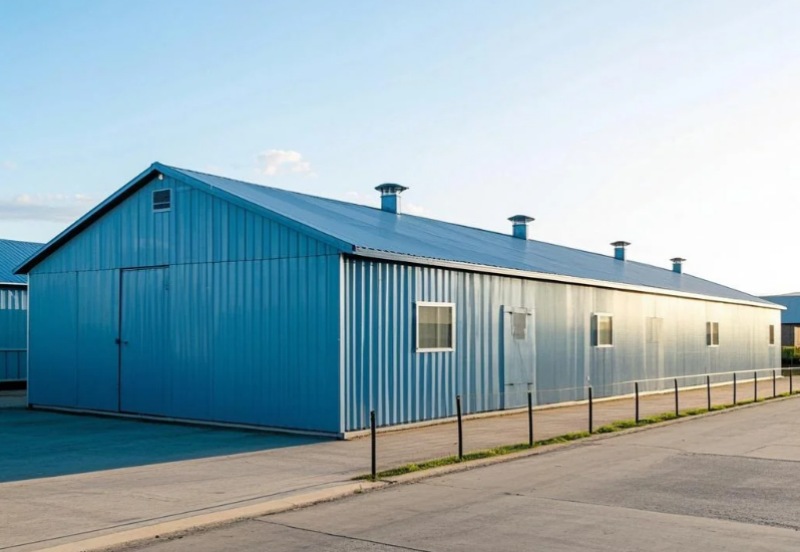
Detailed Explanation of the Cost Structure of Steel Structure Chicken Coops
From an overall budget perspective,the investment in a steel structure chicken coop typically consists of the following core components.The cost will vary depending on the scale,but the overall breakdown is roughly as follows:
1.Main Steel Structure(approximately 25%–35%of total cost)
This is the"skeleton"of the chicken coop.It includes steel columns,beams,purlins,and support systems.
In the US market,the material and processing costs for a typical light steel structure are usually$12–$20 per square foot.Hot-dip galvanizing will slightly increase the price,but extend the lifespan by 5–10 years.
The reason it accounts for 25%–35%is that as the scale increases,the amount of steel used per unit decreases,while the cost of equipment systems increases.
Simply put:the larger the scale,the lower the proportion of structural costs.
2.Enclosure System(approximately 15%–20%of total cost)
The enclosure system refers to the roof panels,wall panels,and insulation materials.The price of the enclosure system is typically$6–$15 per square foot.
Common options include:
Single-layer corrugated steel panels:approximately$6–$8 per square foot,suitable for farms with mild climates and low insulation requirements.
Rock wool sandwich panels:approximately$10–$13 per square foot,suitable for farms in areas with low winter temperatures or requiring some insulation.
Polyurethane sandwich panels:approximately$14–$18 per square foot,suitable for year-round operation,extreme climates,or high-density farming environments.
3.Foundation and Substructure Construction(approximately 10%–15%of total cost)
While steel structures are relatively lightweight,chicken houses still require a stable foundation.
Common Foundation Types and Costs
1.Strip Foundation:Approximately$5–$8/square foot,suitable for light steel-framed chicken houses and small farms.
2.Independent Foundation:Approximately$8–$12/square foot,suitable for small to medium-sized chicken houses or sites with complex foundation conditions.
3.Concrete Slab Foundation:Approximately$10–$15/square foot,suitable for large chicken houses,high-density farming,or sites requiring long-term use.Labor costs are high in the US,so foundation construction costs are typically$5–$12/square foot.Costs will increase if the foundation requires reinforcement(e.g.,soft soil or wetlands).
Foundations and infrastructure are often overlooked,but they can frequently exceed your budget,so they deserve attention.
4.Ventilation and Environmental Control Systems(approximately 15%–20%of total cost)
Modern farming places high demands on ventilation systems.Investment in this area is approximately$6–$18/square foot,depending on the level of automation.
Adding negative pressure fans,evaporative cooling pads,or automatic temperature control devices will typically consume a significant portion of your budget.
If you plan to operate year-round,rather than seasonally,this part is essential.
5.Automated Feeding and Watering Systems(approximately 10%–15%of total cost)
Standard automated feeding and watering systems typically cost$4–$12 per square foot.The unit cost decreases slightly with larger scale.
Automation significantly improves efficiency and reduces labor costs.For large-scale layer hen farming,the payback period for this investment is typically 2–4 years.
6.Manure Treatment and Ancillary Systems(approximately 5%–10%of total cost)
With increasingly stringent environmental regulations,manure treatment systems have become a necessity.The cost is generally$2–$8 per square foot.
Includes:Automatic manure scraping system
Fermentation treatment area
Drainage and sewage pipelines
Cost Structure Summary (Reference Percentages)
| Item | Percentage Range |
|---|
| Main Steel Structure | 25%–35% |
| Enclosure System | 15%–20% |
| Foundation Construction | 10%–15% |
| Ventilation System | 15%–20% |
| Feeding and Drinking System | 10%–15% |
| Manure and Auxiliary Facilities | 5%–10% |
As you can see,the real"budget drain"isn't on the steel itself,but on the equipment system.
Why Choose a Steel Structure Chicken House?
Many farmers hesitate when first considering building a chicken house.Brick and concrete structures seem"sturdy,"durable,and reliable,so why choose a steel structure?Actually,this choice isn't just about being trendy;it's based on considerations of economy,efficiency,and long-term benefits.
1.Significantly Shorter Construction Period
Traditional brick and concrete chicken houses typically take 3–5 months to complete,from digging the foundation to building the walls and then to topping out.For poultry farmers,this period not only means construction costs but also the inability to start operations,resulting in significant capital tied up.
In contrast,steel-structured chicken houses use prefabricated components.Beams,columns,wall panels,and roof components are prefabricated in the factory,requiring only on-site assembly.The main structure can typically be completed in 4–8 weeks.You can see a complete chicken house prototype in about a month,saving considerable time and labor costs.
For example,if you plan to start poultry farming in the spring,a steel-structured chicken house can be completed almost at the optimal time,while a brick-and-mortar structure might miss the best breeding season.Time is money,and this is especially evident in commercial poultry farming.
2.Large-span spaces facilitate large-scale farming
Another advantage of steel structures is the ability to achieve large-span designs,typically reaching 40–60 feet(approximately 12–18 meters)without a central column.Such spaces are crucial for modern poultry farming.
The spacious interior not only facilitates ventilation and lighting but also allows for more flexible equipment layout.Automatic feeding systems,watering systems,and temperature control equipment can be neatly arranged,reducing blind spots and improving management efficiency.
Imagine a chicken coop with load-bearing columns in the middle;it not only affects the layout of passageways but can also become a hygiene dead zone.The large-span design of steel structures completely eliminates these problems,making the interior of the chicken coop more organized and operations more efficient.The advantages of large-scale farming are thus more easily demonstrated.
3.More Suitable for Future Expansion
The poultry industry often experiences growth:as orders increase or farming experience accumulates,the area ofthe chicken coop may need to be expanded.The modular design of steel-structured chicken coops makes expansion relatively simple—you can extend the length or add auxiliary units to the existing structure.
In contrast,expanding brick-and-mortar chicken coops is difficult,not only due to complex construction but also the potential impact on the safety of the original structure,higher costs,and even the possibility of partially demolishing and rebuilding the original building.Steel-structured chicken coops offer flexibility,allowing farmers to adapt to business growth at any time.
4.More Stable Seismic and Wind Resistance
Lightweight steel structures are not only lightweight but also high-strength.They perform better than traditional brick-and-mortar structures in terms of seismic and wind resistance.This is especially important in areas prone to hurricanes or high earthquake risk.
In real-world cases,after hurricanes or severe storms,steel-structured chicken houses typically only require inspection of connectors and roof fasteners,while brick-and-mortar chicken houses may suffer serious problems such as wall cracks and roof damage,requiring additional repairs or reconstruction.The stability of steel-structured chicken houses reduces the risks and losses caused by sudden weather events,providing farmers with more reliable protection.
Differences between Steel-Structured Chicken Coop and Traditional Brick-and-Mortar Chicken Coop
When choosing a chicken house,many farmers compare the advantages and disadvantages of steel-structured and traditional brick-and-mortar chicken houses.From construction period,cost,maintenance,expansion capabilities to space utilization,each has its own characteristics.The following table,combined with textual explanations,will help you understand the differences more intuitively:
| Comparison Item | Steel Structure Chicken Coop | Traditional Brick-and-Mortar Chicken Coop |
|---|
| Construction Period | Fast (1–2 months) | Slow (3–5 months) |
| Initial Cost | Medium | Slightly Lower |
| Maintenance | Low | Higher |
| Expansion Difficulty | Easy | Difficult |
| Seismic Performance | Good | Average |
| Space Utilization | High | Limited by Structure |
As you can see from the table,steel structure chicken coops have significant advantages in construction speed,ease of expansion,and space utilization.For example,a steel structure chicken coop can be completed in 1–2 months,while a brick-and-concrete chicken coop often takes more than three months to be operational.For farmers who want to start raising chickens quickly,this means saving a lot of time and reaping profits sooner.
While brick-and-concrete chicken coops are slightly cheaper in terms of initial cost,their long-term operating costs are much higher.Brick-and-concrete chicken coop walls are prone to dampness and cracking,requiring frequent and expensive maintenance,while steel structure chicken coops only require regular checks of the steel,rust prevention,and roof fasteners,making maintenance simple and inexpensive.
In terms of expansion capabilities,steel-structured chicken houses can be modularly extended,making it very convenient to increase the breeding area in the future.Expanding brick-and-mortar chicken houses is difficult,requiring rebuilding the foundation or demolishing the original structure,which is both time-consuming and labor-intensive.
Earthquake resistance and wind resistance are also highlights of steel-structured chicken houses.Lightweight steel has high strength and good toughness,maintaining the stability of the chicken house even in earthquakes or strong winds,while brick-and-mortar chicken houses are prone to wall cracks or roof damage,increasing safety risks.
Regarding space utilization,the large-span design of steel structures allows for almost column-free interiors,enabling more flexible layout of passageways and equipment,and reducing dead corners.Brick-and-mortar chicken houses,due to the limitations of load-bearing walls and central columns,have restricted internal layouts,easily leading to wasted space,especially in large-scale farming.
In the short term,brick-and-mortar structures may have a slight advantage in initial costs,but considering long-term operation and flexibility,steel-structured chicken houses are clearly a more worthwhile investment.
Budget Reference for Steel Structure Chicken Houses of Different Sizes
In the US market,the investment cost of steel structure chicken houses varies greatly depending on the scale of the operation,insulation materials,foundation type,and equipment configuration.Below are some reference ranges to help you quickly understand your budget:
1.Small Family Farm(approximately 2,000 square feet)
Total Cost:Approximately$70,000–$120,000
Suitable for:Initial trial farming,family sideline,or small farms.
Features:Relatively low investment,short construction period,suitable for flexibly trying different farming models.
2.Medium-Sized Commercial Farm(approximately 10,000 square feet)
Total Cost:Approximately$400,000–$700,000
Suitable for:Professional farmers or large-scale farms.
Features:Ample space,can accommodate automated equipment,improving management efficiency;cost per unit area is slightly lower than small farms.
3.Large-scale standardized farming(30,000 sq ft and above)
Total Investment:$1.2M–$2.5M+
Applicable Scenarios:Large-scale commercial farming,standardized operations,or supply chain companies.
Features:Significantly lower unit costs;economies of scale can significantly increase profit margins,but requires higher planning and capital investment in the early stages of construction.
Based on the above references,you can choose an appropriate scale according to your own needs and investment capabilities,rather than blindly pursuing"large and comprehensive,"avoiding wasted funds or excessively long construction periods.
How to Effectively Control the Construction Cost of Steel Structure Chicken Houses
Many farming projects exceed their budgets not because steel or sheet metal is expensive,but because of insufficient early planning.Mastering a few key strategies can make costs more controllable:
Choose standardized designs
Standardized chicken house designs are more economical in material procurement and construction,reducing additional costs caused by customization errors.
For example,the common modular design with a span of 40–60 feet can meet most farming needs and facilitates later expansion.
Optimize Span,Avoid Over-Design
While steel structures can achieve large spans,over-design not only increases material costs but also construction difficulty.
Choose an appropriate span based on the scale of the operation and equipment layout,avoiding the misconception that"bigger is better."
Adjust Insulation Level According to Climate
The climate varies greatly across different regions of the United States.In colder regions,polyurethane sandwich panels offer good insulation,while in hotter regions,single-layer color steel panels or rock wool sandwich panels can reduce costs.
Appropriately configuring the insulation level ensures a comfortable chicken house while avoiding unnecessary high expenses.
Phased Construction
For farmers with limited funds or those wishing to expand flexibly,it's advisable to build the core chicken house and infrastructure first,adding auxiliary modules later as needed.
Phased construction not only reduces the initial financial burden but also allows for optimization of subsequent designs based on actual operational conditions.
By using these methods,you can effectively control construction costs and avoid overspending while ensuring the functionality and safety of the chicken house,and leave room for future expansion or large-scale operation.
FAQs about Steel Structure Chicken Coop
Q1:How many years can a steel structure chicken house be used?
Under normal maintenance conditions,the lifespan is typically 20–30 years.
Using hot-dip galvanized steel can further extend this lifespan.
Q2:Will a steel-structured chicken house be too cold in winter?
This depends on the enclosure system.Using high-grade insulated sandwich panels provides sufficient insulation for cold regions.
Q3:Which is more cost-effective,a steel-structured chicken house or a brick-and-mortar chicken house?
In the short term,brick-and-mortar construction costs may be slightly lower.However,considering construction time,ease of expansion,and maintenance costs,steel structures are more advantageous in the medium to long term.
Q4:Is a steel-structured chicken house suitable for laying hens or broilers?
Both are suitable.However,large-scale laying hen farming relies more on automation systems,thus steel structures are more commonly used.
Conclusion
Is building a steel-structured chicken coop worthwhile?
If you are only temporarily raising chickens or conducting small-scale experiments,a traditional structure may be sufficient.
But if you plan for long-term operation,want to increase automation,and hope to expand in the future,then a steel-structured chicken house undoubtedly has more modern advantages.
Cost is not just a number.More importantly,can it support the sustainable development of your farming model?
In today's increasingly large-scale agriculture,the structural form often determines the upper limit of efficiency.