How Much Does It Cost to Build a Steel Logistics Warehousing Center
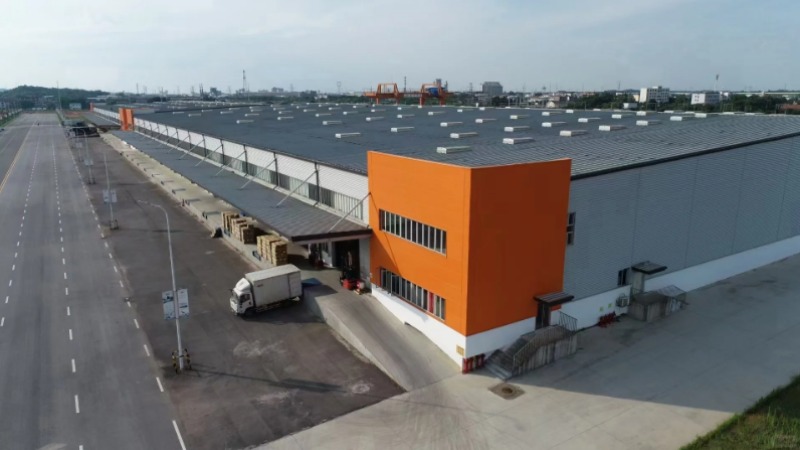
If you are planning to build a logistics warehouse,distribution center,or large-scale warehousing center,then budget is almost certainly the first issue to consider.
The construction cost of a typical steel structure logistics warehousing center is usually between$50 and$150 per square meter.For automated warehousing centers,cold chain logistics warehouses,or high-standard distribution centers,the overall cost will be even higher.
For most investors,instead of rushing to find a fixed price,it's better to understand what factors affect the construction cost of a logistics warehousing center.This will not only allow for a more accurate budget assessment but also avoid additional expenses due to later adjustments to the plan.
Next,we will provide a detailed analysis of price range,cost structure,influencing factors,and practical examples to help you gain a more comprehensive understanding of the investment cost of a steel structure logistics warehousing center.
What is the price range for a steel structure logistics warehousing center?
Different uses for logistics warehouses lead to different design standards.Some warehouses are only used for general goods storage,while others need to meet the requirements of e-commerce logistics,cold chain distribution,or automated storage and retrieval systems.Different uses determine the differences in building configuration,which directly affects the final cost.
If you're building a basic storage warehouse,typically using a standard corrugated steel enclosure system with no complex internal equipment,the cost per square meter is relatively low.However,for large logistics and distribution centers,high headroom,large spans,loading and unloading platforms,and fire protection systems are often essential,naturally increasing the overall budget.
To help you get a basic idea,you can refer to the following market price range:
Warehouse Type | Estimated Cost |
Basic Storage Warehouse | $30–50/㎡ |
Standard Logistics Warehouse | $50–90/㎡ |
Insulated Logistics Warehouse | $90–150/㎡ |
Automated Logistics Center | $150–300/㎡ and above |
Besides the unit price,many investors are more concerned about the overall project budget.
Here are some reference ranges for common warehouse sizes:
Building Area | Estimated Cost Range |
500㎡ | $25,000–$50,000 |
1,000㎡ | $50,000–$100,000 |
5,000㎡ | $250,000–$500,000 |
10,000㎡ | $500,000–$1,000,000+ |
It should be noted that these figures are for initial project budget reference only.Actual quotes will be calculated based on the project location,wind and snow load requirements,and specific building plans.
Therefore,when you see significant price differences between different suppliers,it doesn't necessarily mean that one supplier's quote is higher or lower;rather,the underlying design conditions may be completely different.
Why are there such large price differences for warehouses of the same size?
This is one of the most confusing questions for buyers in logistics and warehousing projects.Many clients come with two quotes and ask,"Why is there such a big price difference for a 1000 square meter warehouse?"
In fact,area is only one factor affecting cost.In the field of steel structure construction,the actual cost is often determined by building parameters and usage requirements.
The following factors typically have a direct impact on the final budget:
Building Area
For most steel structure projects,the larger the building area,the lower the unit cost.
This is because design,transportation,and some installation costs can be spread across a larger building area.For example,a 500-square-meter warehouse and a 5,000-square-meter warehouse,although constructed similarly,will generally have a lower cost per square meter due to economies of scale.
However,this does not mean that a larger area necessarily means a lower total investment.With increased area,the total amount of steel,enclosure systems,and foundation work also increases,thus raising the overall budget.
For companies planning logistics centers,a reasonable assessment of future business scale is crucial.A warehouse that is too small may limit development,while one that is too large will increase unnecessary investment costs.
Warehouse Height
Warehouse height is one of the important factors affecting cost,but many non-professional buyers often overlook this.
With the development of the modern logistics industry,high-bay racking is becoming increasingly common.To increase storage capacity,many logistics centers adopt headroom designs of 8 meters,10 meters,or even 12 meters or more.
Increased height means longer steel columns and larger steel beams,while also placing higher demands on the overall structural stability.Therefore,even with the same building area,differences in height can lead to significant cost differences.
For example,consider two warehouses,each with an area of 2000 square meters.One has an eaves height of 6 meters,while the other has an eaves height of 10 meters.The latter will typically require significantly more steel,resulting in a higher final cost.
Clear Span Design
If you've visited a modern logistics center,you'll notice that there are almost no columns inside.
This open-plan design provides greater flexibility for forklift access,racking layout,and cargo loading and unloading,making it widely popular among logistics companies.
However,large spans don't come without a price.
As the span increases,the load on the main steel beams also increases,requiring larger steel components.Therefore,while a 30-meter span offers a better user experience compared to a 20-meter span,it is often more expensive.
For logistics and warehousing centers,designers typically seek a balance between cost and space utilization,rather than solely pursuing maximum span.
Insulation and Enclosure Systems
Many clients focus only on the steel structure at the initial project stage,neglecting the impact of the enclosure system on the budget.
In fact,wall and roof systems often constitute a significant portion of the project cost.
If the warehouse is only used for general goods storage,single-layer color steel panels are usually sufficient.However,for food storage,pharmaceutical logistics,or cold chain projects,insulation materials such as rock wool sandwich panels and polyurethane sandwich panels are more common.
The price differences between different enclosure materials are significant,thus affecting the final cost.
Project Location
The same warehouse design can have vastly different costs depending on the country of construction.
For example,Southeast Asia prioritizes wind resistance,while North America and Northern Europe require careful consideration of snow load requirements.Stricter local building codes generally necessitate higher specifications for the steel structure.
Furthermore,transportation distance,labor costs,and installation conditions all influence the total project budget.
Therefore,when requesting a quote,suppliers typically inquire about the project location first.This isn't an unnecessary question,but rather a key factor determining the accuracy of a quote.
Where does the money for building a logistics warehousing center primarily go?
For investors building a logistics warehouse for the first time,a common misconception is that the steel structure quote equals the total project cost.
In reality,when a supplier provides a quote for the main steel structure,it's often only a part of the overall project budget.For the warehouse to be truly operational,multiple stages are involved,including foundation work,enclosure systems,electrical lighting,fire protection facilities,and installation.
Many projects focus solely on the price of the main steel structure during the initial budgeting phase,only to discover after construction begins that the actual expenditure far exceeds expectations.Therefore,understanding the cost structure of a logistics warehousing center is crucial for controlling investment risk.
Generally,the cost distribution of a standard logistics warehousing center is roughly as follows:
Cost Category | Typical Share of Total Cost |
Steel Structure | 35%–50% |
Roofing & Wall Cladding | 15%–25% |
Foundation Works | 10%–20% |
Doors, Windows & Loading Systems | 3%–8% |
Electrical Systems | 5%–10% |
Fire Protection Systems | 5%–15% |
Installation & Construction | 10%–20% |
While the steel structure is the core of the warehouse,it is not the only major expense.
Taking a 5,000-square-meter logistics warehouse as an example,many clients initially only focus on the amount of steel used in the steel structure,neglecting supporting facilities such as loading/unloading platforms,fire sprinkler systems,and outdoor roads.These ancillary works can sometimes account for more than 30%of the overall budget.
Therefore,when planning a project,instead of focusing solely on steel prices,it is better to conduct a budget assessment from the perspective of the overall investment,which will yield more accurate cost data.
What is the difference between a logistics center and a regular warehouse?
Many companies have a question at the beginning of a project:Both logistics centers and regular warehouses seem to be buildings for storing goods,so why are logistics center construction costs often higher?
In fact,although they look similar,their usage requirements are completely different.
Regular warehouses primarily serve a storage function,with relatively low goods turnover.Meeting basic storage needs is sufficient;space utilization and loading/unloading efficiency requirements are not particularly high.
Logistics warehousing centers,however,are different.The modern logistics industry emphasizes rapid turnover and high-efficiency delivery.From truck entry and loading/unloading operations to goods leaving the warehouse,every step requires a more rational spatial layout.
Therefore,logistics centers typically employ a larger clear span design to reduce the impact of internal columns on forklift operation.They also feature more loading/unloading platforms to improve vehicle turnover efficiency.
Below is a simple comparison of the two:
Feature | Regular Warehouse | Logistics Center |
Storage Function | Basic Storage | Storage + Distribution |
Clear Span | Standard | Large Clear Span |
Building Height | 6-8m Typical | 8-12m+ Typical |
Loading Docks | Limited | Multiple Loading Docks |
Material Handling | Basic | High-Frequency Operations |
Automation Compatibility | Limited | High |
Fire Protection Requirements | Standard | Enhanced |
Construction Cost | Lower | Higher |
With the development of e-commerce logistics,more and more companies are starting to build high-standard logistics centers.While initial investment may increase,higher operational efficiency often leads to better returns in the long run.
How to Reduce the Construction Cost of Logistics Warehousing Centers?
Building a logistics warehousing center is a long-term investment,so most companies focus on controlling the budget while ensuring building quality and meeting usage needs.In fact,reducing costs doesn't mean simply cutting corners or choosing cheaper materials,but rather making more rational decisions during the project planning phase.
From practical project experience,many warehouse cost differences don't occur during construction but are already established before the design is finalized.Optimizing building area,span,height,and material configuration can often effectively reduce overall investment without affecting usability.
Rational Warehouse Area Planning
In logistics warehousing projects,building area directly determines the overall investment scale.Therefore,before starting the project,companies first need to clarify their current business needs and development plans for the next few years.
Some companies want to build large warehouses exceeding their actual needs to avoid later expansion.However,excessively large building areas not only increase construction costs but also raise subsequent operating and maintenance expenses.In contrast,planning according to actual needs and reserving conditions for future expansion is usually a more economical approach.
Choosing an Economical and Reasonable Span Design
The net span is one of the important factors affecting the amount of steel used in steel structures.For logistics warehouses,a larger span can reduce internal columns,improve forklift operation efficiency,and increase space utilization,thus attracting many companies.
However,a larger span is not always better.As the span increases,the main steel beams and support system need to withstand greater loads,and the amount of steel used will also increase significantly.For example,compared to a 24-meter span,a 30-meter span,while offering more open internal space,usually results in a significantly higher overall cost.Therefore,choosing an economical span,while meeting operational needs,often yields better cost control.
Determining Building Height Based on Usage Requirements
In recent years,with the development of automated warehousing,high-bay racking systems have become increasingly common,leading many logistics centers to adopt taller building designs.However,not all projects require a net height of 10 meters or even 12 meters or more.
Every meter increase in building height not only increases the cost of the main steel structure but also the enclosure system,installation,and subsequent energy consumption for lighting and air conditioning.If the warehouse is mainly used for storing general goods,choosing an appropriate building height is often more reasonable than blindly pursuing a larger space.
Prefabricated Steel Structures Preferred
Compared to traditional construction methods,the biggest advantage of prefabricated steel structures is their rapid construction speed.Most components are manufactured and pre-processed in the factory and can be directly transported to the site for installation,reducing on-site construction work.
For logistics companies,shorter construction cycles mean warehouses can be operational and generate revenue sooner.Simultaneously,factory production effectively reduces material waste and improves construction precision,further controlling overall costs.
Choosing Enclosure Systems Based on Actual Needs
Besides the main steel structure,wall and roof systems are also significant components of warehouse construction costs.Different enclosure materials vary significantly in price,insulation performance,and lifespan.
If the warehouse is primarily used for general goods storage,single-layer color steel panels are usually sufficient.However,for food storage,pharmaceutical logistics,or cold chain projects,sandwich panel systems with better insulation are required.Therefore,choosing the appropriate enclosure solution based on the actual application scenario not only reduces initial investment but also helps reduce subsequent operating costs.
Selecting Experienced Steel Structure Manufacturers
The supplier's design capabilities and project experience also affect the final cost.Experienced steel structure manufacturers can typically optimize structural solutions based on project location,building purpose,and local regulations.
In actual projects,by rationally adjusting component specifications,node design,and structural layout,unnecessary steel waste can often be reduced,further lowering construction costs while ensuring safety.Therefore,rather than simply comparing prices,it's better to consider the supplier's design capabilities and project experience.
Overall,cost control for logistics and warehousing centers should begin in the design phase,rather than waiting until construction.Reasonable area planning,economical span design,appropriate building height,and professional structural optimization can all help companies achieve a higher return on investment while ensuring warehouse performance.
How long does it take to build a logistics and warehousing center?
Besides budget,construction time is also a major concern for companies.Especially for rapidly growing logistics companies,the ability to put the warehouse into operation as quickly as possible directly impacts operational plans.
One of the biggest advantages of steel structure buildings is their speed of construction.Compared to traditional concrete buildings,steel structural components can be prefabricated in factories,significantly reducing on-site construction time.
Generally,the construction cycle for a logistics and warehousing center is as follows:
Project Phase | Typical Duration |
Design & Planning | 1–2 Weeks |
Structural Engineering | 1 Week |
Manufacturing | 3–6 Weeks |
Shipping & Delivery | 2–6 Weeks |
Installation & Assembly | 2–8 Weeks |
For most projects,it typically takes 2 to 4 months from finalizing the design to putting it into operation.
If the project is large-scale or the transportation distance is long,the time may be extended accordingly.
How to Get an Accurate Quote?
If you have already started planning your project,the most important step is to obtain an accurate quote.
However,many clients only provide an area figure when inquiring.
For example:
"I want to build a 3000 square meter warehouse,how much will it cost?"
In fact,it is difficult to calculate the true cost based solely on the area.
To obtain a more accurate quote,it is recommended to prepare the following information in advance:
Project location
Building length
Building width
Building height
Wind load requirements
Snow load requirements
Is insulation required?
Number of doors and windows
Is an office area included?
Is a loading and unloading platform required?
Is overhead cranes or automated equipment required?
The more complete the information,the smaller the quote error.
At the same time,the design scheme will be more in line with actual usage needs.
Steel structure logistics and warehousing centers are commonly used.
FAQs about steel structure logistics warehouse
How much does a 5,000 square meter logistics warehouse cost?
Typically,it ranges from$250,000 to$500,000.The specific price depends on the height,span,insulation configuration,and local building codes.
Are steel structure warehouses cheaper than concrete warehouses?
In most cases,yes.Steel structures are faster to construct,have lower labor costs,and are easier to expand later.
Can logistics warehouses be expanded later?
Yes.Steel structure buildings have good scalability,making it relatively easy to increase the length or expand the warehouse later.
Do I need to go through approval procedures to build a logistics warehouse?
Yes.Specific requirements vary by country and region.It is recommended to consult the local building authorities in advance.
Why are automated logistics centers more expensive?
Because they require higher building standards,larger headroom,and automated equipment systems,the overall investment is usually higher than that of ordinary warehouses.
Get your customized logistics warehousing center solution
Every logistics project has its own characteristics.
Different warehouse areas,types of goods,operating models,and local building codes will result in different final design schemes and budgets.
WZHbuild specializes in steel structure warehouse and logistics storage center solutions,providing clients with a one-stop service from design,manufacturing,transportation to installation support,tailored to project location,usage requirements,and budget.
Whether you're planning to build a small to medium-sized logistics warehouse or a large distribution center,we can offer professional advice and customized solutions.
If you are planning a logistics storage project,please contact WZHbuild for exclusive design solutions and detailed quotes.